How To Choose The Best Hunting Catapults For Survival
One of the oldest weapons used for hunting has got to be the catapult and a very good bit of survival kit to have in your bug out bag. But what are the best, value for money, hunting catapults for survival that you, as a prepper, should consider buying.?
Hunting Catapults can be made from very basic materials and with practice can be very effective - Today's Hunting Catapults are considered a much more lethal and accurate weapon than ever before. Made from high-tec materials and design giving you a serious weapon.
In a survival situation they would become an essential food hunting tool.
Firstly, let's look at the pros and cons of adding a hunting catapult to your survival kit - Along with your survival knife and a multi tool knife, a hunting catapult is quite low-tec in it's principle design and operation, relying more on your own skill than the actual catapult itself.

See full range of catapults here:
Hunting Catapults
Essentials to consider when choosing the Best Hunting Catapults For Survival
Pros of Hunting Catapults:
- Accurate and deadly
- Very quiet operation
- Easy to load and reload
- Fast reload [with practice]
- Simple operation
- Compact
- Light weight
- Main working parts are easily changes or repaired
- Low initial cost
- Unlimited supply of ammunition if needed [ eg – stones]
A starter level catapult, like this FNK Hunting Catapult Set (shown below) need not not be expensive too.
This kit sells for only £14.99 and just right for beginners.


Cons of a Hunting Catapults:
- Practice required to build up accuracy
- Ammunition can be bulky and weighty [ 200x 8mm ball bearings would weigh about 1.5lb ]
- A supply of replacement catapult bands is required
Highly Polished 6mm Steel Shot is also readily available.
This tin of 250 sells for £5.15


Essentially the hunting catapult has only three components, making it ideal as a low maintenance and easily repairable bit of kit.
The frame, firing bands and pouch - it is also very easy to make your own for forage materials: wooden frame from a tree branch, leather pouch from an old shoe and firing bands for strips of an old cycle inner tube tyre.

Choosing The Best Hunting Catapult
Anybody who has used a catapult before will tell you how invaluable it can be in survival situations.
Like any good hunting weapons, not every catapult is made equal. There are a few different features that you should think about which will enable you to choose the right hunting catapult for you
1. Frame Material
There are three main frame materials, namely: plastic, wood and metal. Having different materials to choose from will offer you equally different advantages and disadvantages.
If you know the differences around what each one can offer, there's a much better chance you choosing the best hunting catapult for you.


– Most economical to manufacture and this reflects in the cost.
– Various plastic sub-types available. Offering different advantages in grip and feel as well.
– Glass-filled nylon also offers excellent frame material if you’re looking for a lighter catapult.


– Wooden catapults are the oldest types there is.
– Generally mimicking the 'Y' of a tree branch, but can be formed into many different shapes through laser cutting or hand shaping
-- They tend to offer a good 'feel', and you can make them yourself relatively easily.


– These catapults can offer a light and strong body.
– However, they are generally the most expensive of the three.
-- They are the most robust and longest-lasting frame material you can get.
– Choosing steel or aluminium frame catapults that have an ergonomic handle with added foam, rubber or cord wrapping also offers comfort to the mix.
2. FIRING BAND TYPES:
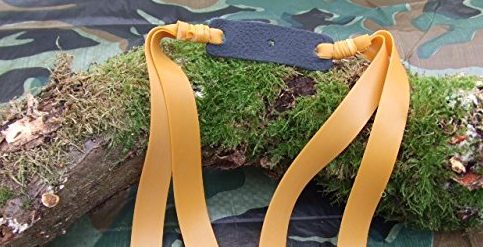
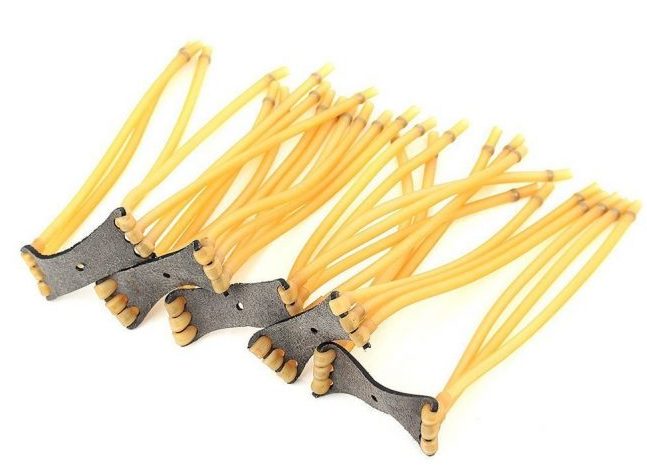
There are essentially two main band types in use within the market today- the flat rubber type and the tubular band type.
Each band type has a more specific use and will depend on what you intend to use the catapult for.
The rubber tubing type is better known for being durable, as opposed to a catapult with the flat rubber bands generally provide a a more accurate shot and are better in hunting scenarios.
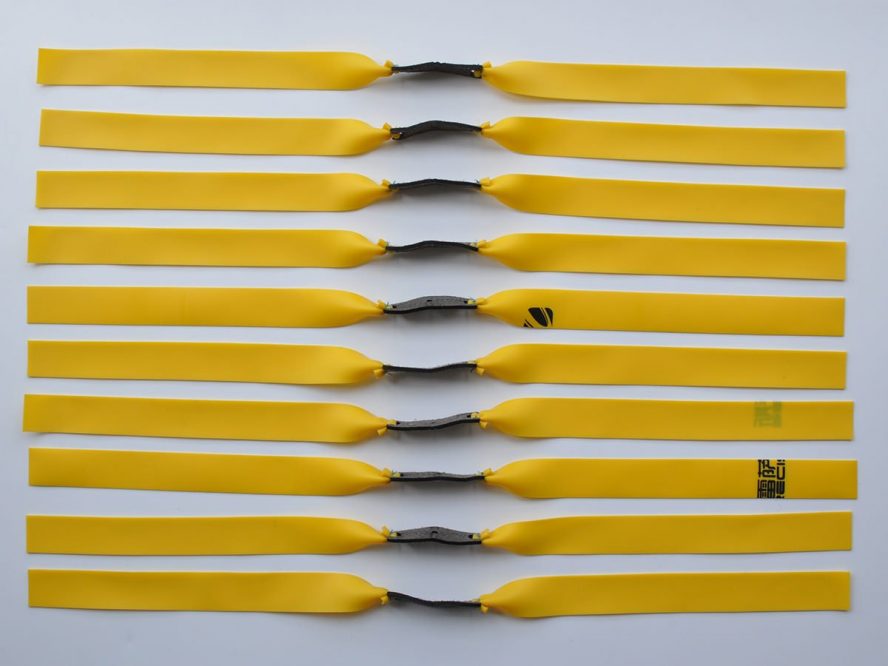
- Flat Bands
– Catapults fitted with the flat bands tend to have a more faster shot and are more accurate, this is due to their rapid “snapback speed” feature ( *The rate at which your projectile moves forward ).
– Flat bands produce a higher 'feet per second' projectile speed with the added advantage of being easier to draw. If you’re firing for accuracy such as hunting, then flat bands are the best choice.
- Rubber Tubing
– Rubber tube band will outlast flat bans. It’s the best set to choose when surviving for longer periods of time.
– Rubber tube bands can offer you a specific draw weight. Choose the type that feels right for your draw strength and the best shooting action/feel.
* The best things is: Firing bands are relatively cheap and easy to get a hold of. Therefore you should test each one out and see which suit you the best.
See a selection of firing bands here;
3: AMMUNITION POUCH:

This may seam like a unnecessary consideration, but the ammo pouch can play it's part in a good catapult. Especially for it's comfort and grip.
Always get a catapult with the pouch made from leather, it will naturally mould to the type and size of the ammo that you use.
Being leather, it's natural properties allow it to remain supple at all times, giving you a feel for the ammo at all times.


4: Other Considerations:
There are many different types o catapults to choose from. Many them come with added features to entice to buyer.
Some of these features can actually add benefits to the product which make it a good purchase.
a) Grip Type:
It is essential that your catapult feels comfortable and has a good grip.
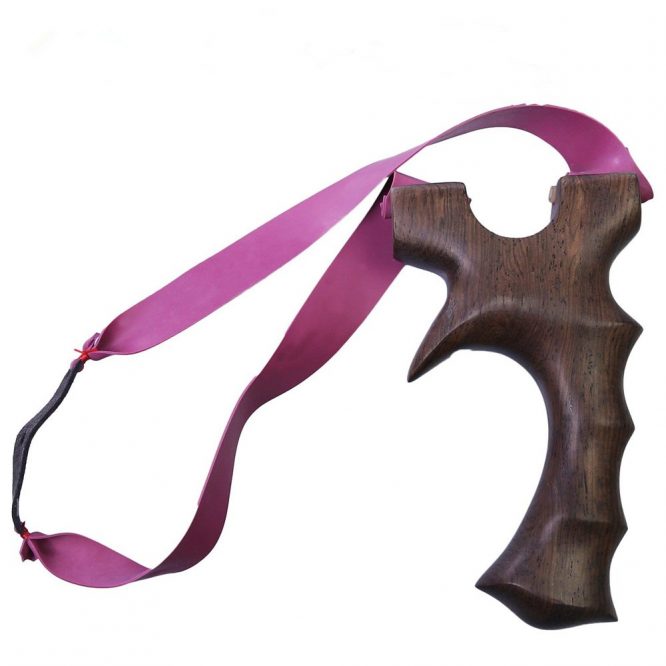
Hunting catapults that provides a good grip do a lot more than just stopping blisters. - It will allow you to practice for longer without hand or wrist fatigue, and give you more shots with better accuracy.
Ergonomic or contoured slingshot handles will fit perfectly in your hand, like this High Velocity Handmade Wooden Catapult shown below:
b) Target Sighting
Having a sight and a point of reference will greatly improves your accuracy of shot.
It's a great addition to a hunting catapult as it will give you a feel for distance and shooting accuracy.
Sights are key to hunting accuracy and will give you a accuracy advantage especially with smaller game.
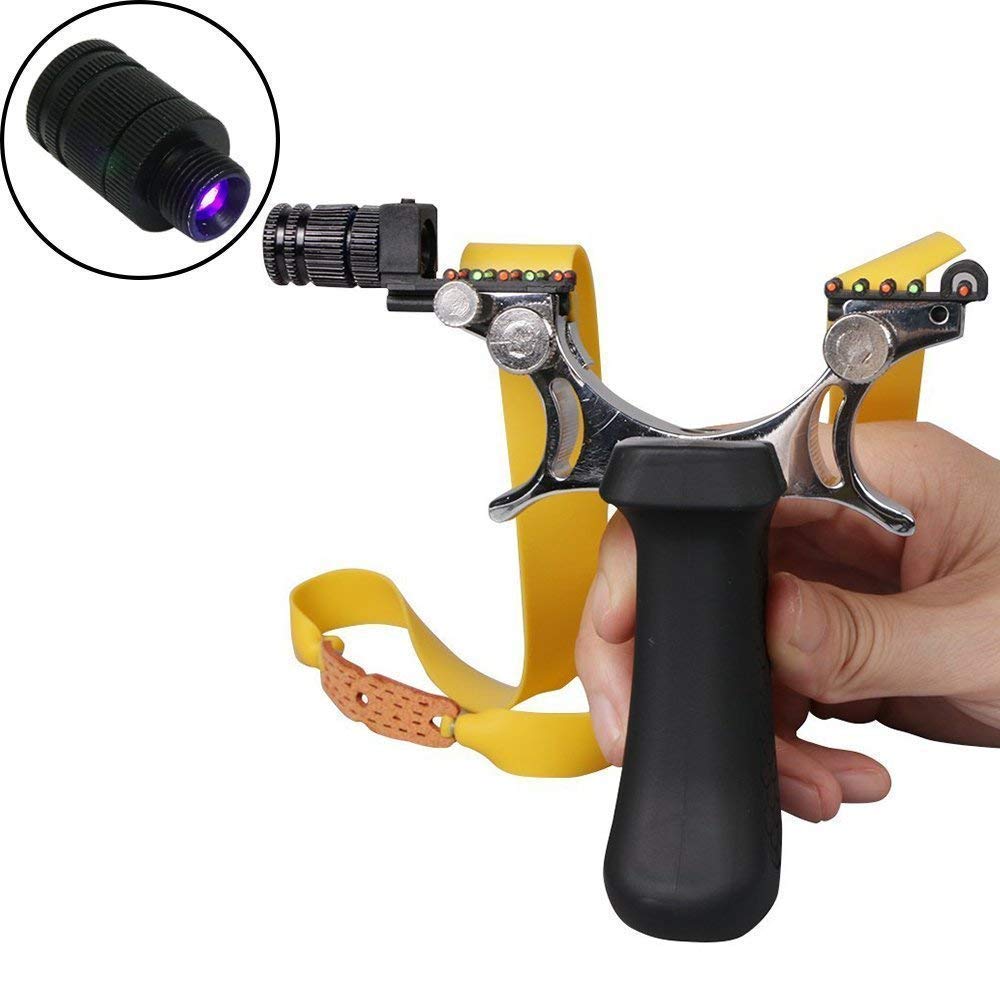
A lot of the top catapults will be fitted with an adjustable sighting systems attached, like this hunting catapult shown below:
c) Hollow Handle
A catapult with a hollow handle is worth considering, they are lighter but, being hollow, a lot less stronger.
However, they offer a space to store spare ammo and other survival gear like spare bands, a fire starter, matches, compass and son on.are great for storing additional ammunition or spare bands. These usually come with a screw-on cap at the base of the handle for access.
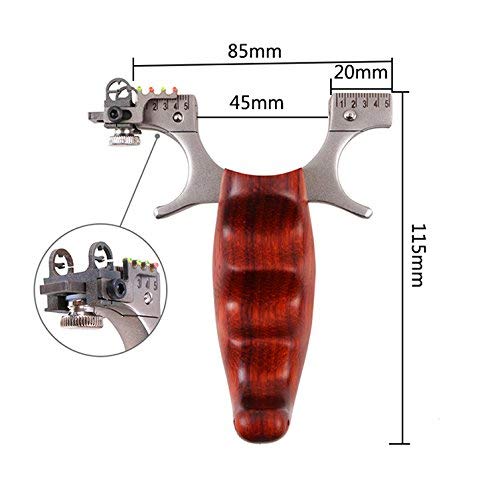
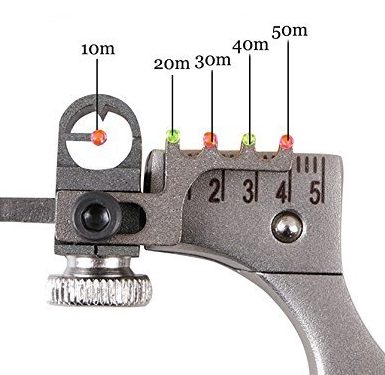
So a hunting catapult can be as low-tec as you want. Of course there are others, much more specific, high-tec catapults available like this calibrated hunting catapult shown here: ( *sells for £35.00)


Wrist Support:
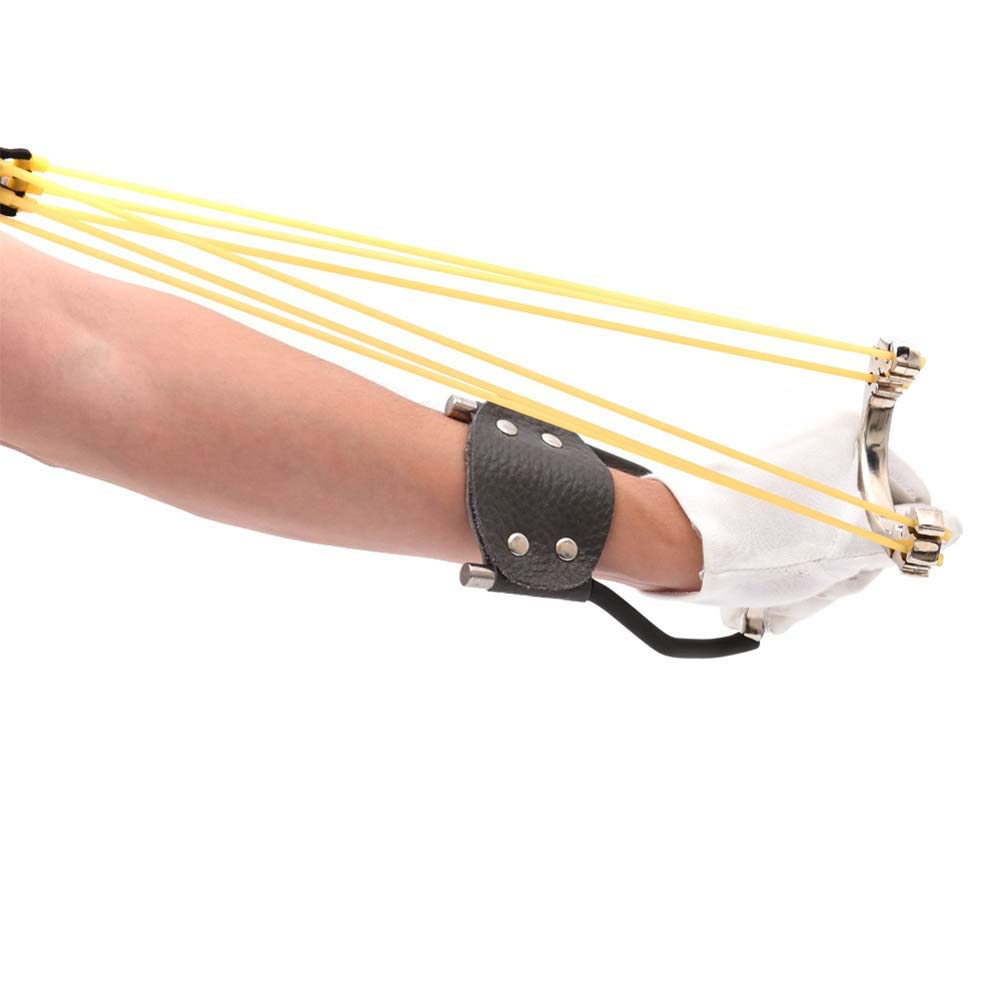
Choosing a hunting catapult with a wrist support can help reduce fatigue and muscle stress, especially when practising and taking lots of shots.
But the main purpose of a wrist support is stability. It will aid you to keep the wrist locked in place in order to line a shot more accurately.
Personally, I don't use them, but if you have weaker wrists or for use with a child they are very good.
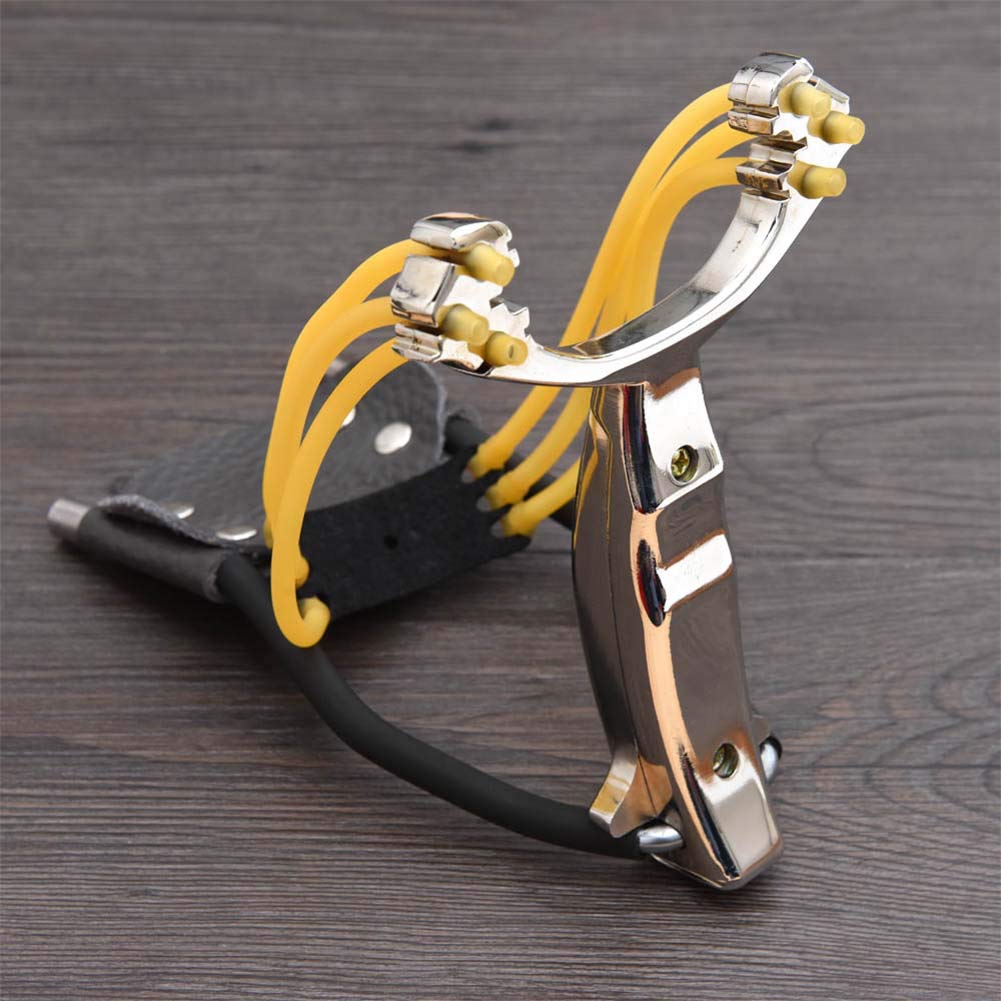
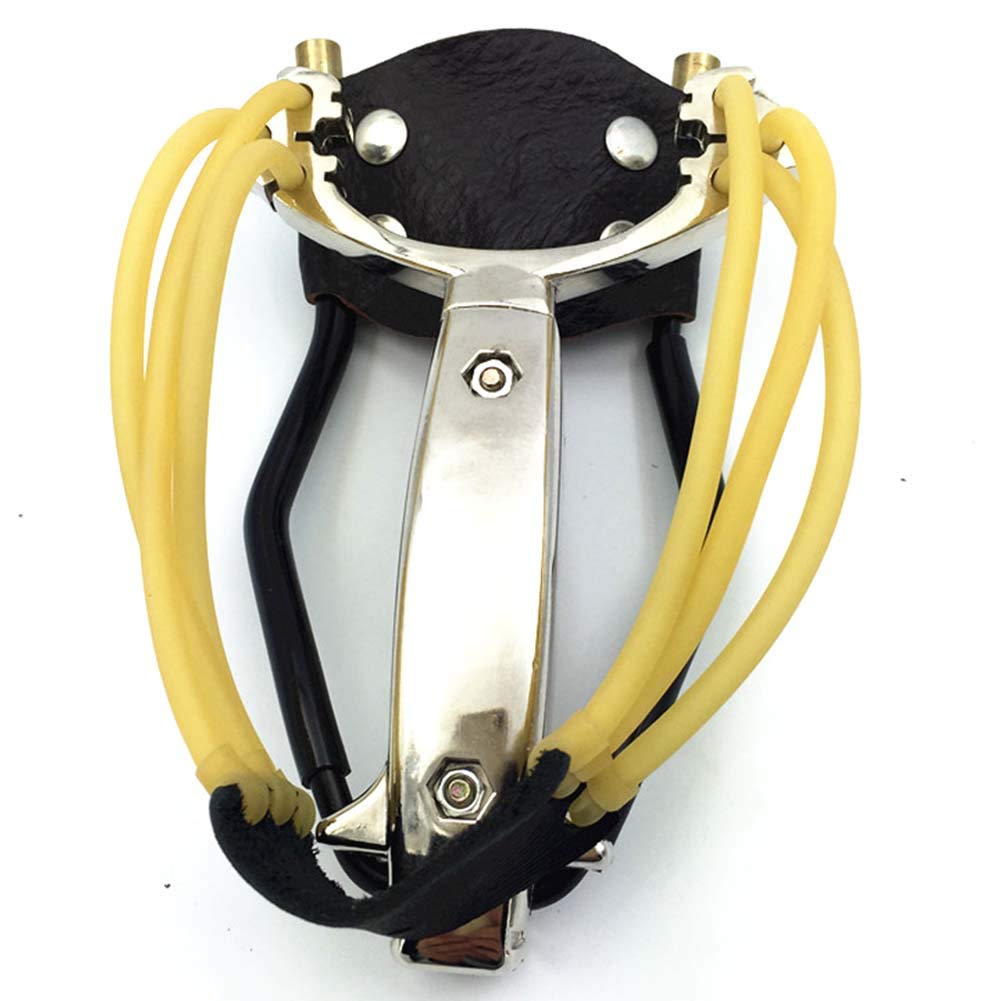
Overall the pros far outweighs the cons making Hunting Catapults a very good survival weapon for preppers.
Remember you will also need a good supply of ammo [ball bearings seem to work best] and also some replacement bands - [the elastic rubber with replacement pouch.]
That said, there are some excellent hunting catapults around today that work really well and all hover around the same price bracket of between £25 - £100 - Replacement bands will cost anything upto £5 to renew and ball bearing ammo [8mm] is around £5 for 200.
ENTRY LEVEL
Kotila UK Powerful New Slingshot Catapult Steel Handle Sling Shot Outdoor Game Hunting (Camouflage)


£7.99
outdoor hunting
Outdoor Hunting Trumark Catapult heavy duty +2PCS Rubber Bands Replacement Animals Heavy Pull+50PCS 7mm Ball Ammo


£14.99
CATAPULT KITS
Powerful Catapult Set, with Ball Bearing / Flat Rubber Bands / Storage Bag / Magnetic Ring


£28.99
- Folding slingshot slingshot set: hunting catapult slingshot made of steel,
- Ball bag: makes loading the slingshot professional for hunting very easy and great fun.
- Magnetic Ring of the Twins Slingshot:
- 100 pcs. Steel round balls 8 mm stainless steel

A catapult is a uniquely stealth hunting tool, and with relatively little practice will offer a very effective method of hunting for small game.
There are cheap yet robust tools with the advantage of few moving parts and ammo that can be found on the ground!
I think all preppers should own at least one.....
Steve Hart - UK Preppers Guide

Eating Insects For Survival
Crickets, Grasshoppers, Maggots & Earthworms
Eating Insects For Survival
Crickets, Grasshoppers, Maggots & Earthworms

Catch em, Dry em, Roast em and Eat em
One thing I will say straight away about how to eat insects is: Whenever possible, roast them first. Yes you can eat pick them up and eat them from the ground, but you never know what nasties have taken up residence on them.
So from a pure 'keeping yourself safe' point of view, do as much as you can to prepare them first.

Crickets and Grasshoppers Are Great Insects To Eat.
* And there easy to catch!
Take a glass jar, like a Mason Jar and lay it on the ground with a little bait.
Use a slice of apple, some old oats, small bits of bread, an old carrot, lettuce, a bit of stale beer.
Anything that you feel is 'on the turn' and cannot be eaten by yourself.
If you can eat it, then do so.!
But when it gets a bit rancid is the time to use it as bait.
Grasshoppers and crickets inhabit pretty much the same types of terrain as each other, are equally as easy to catch and the preparation and cooking are the same as well

Your average cricket or grasshopper is incredibly easy to catch. In fact they actually come to you.!
One of the few food sources that require very little stalking and precious little skills on your part.
Simply cut a plastic bottle 1/4 the way down from the top and invert the cut piece into the bottle.
Sprinkle a layer of sugar into the bottle as bait and leave over night - when you return you should find a nice collection of crickets or grasshopper ready for you.


picture courtesy of WikiHow
They are best left to dry out a bit before roasting or pan frying and can even be fully dried out for extended storage times before cooking.
Some people will spend time removing the legs before cooking as the legs tend to be a bit irritating and will get stuck between your teeth. A downfall of eating insects I suppose....
HOW TO EAT EARTHWORMS
The humble earthworm is a good source of food in a survival situation and highly nutritious.
You can gather a good plate of fresh worms very easily, especially when it is raining, as the worms will come up to the surface to escape from drowning.
You can even entice them out by digging a hole and pouring water all around the area and into the hole - they will soon appear.

Remember - earthworms live underground in the soil and don't mind eating dirt, which make them very crunchy to taste if eaten raw. [but you know my opinion on that - always try to cook them first]
So, in order to reduce the dirt and crunchiness, try to purge them first by giving them all a good soaking in water for a day and then, holding one end of the worm, simply squeeze along the body and remove the dirt out of their body.
They have a distinct bitter taste - not overly bitter and certainly palatable, but bitter nevertheless.

A combination of purging, drying and frying them until crispy makes a very nice snack food or you can add them to other dishes or stews for more nutrition and bulk.
Now you can eat earthworms raw - just pick one up and give it a clean, but they just taste very unpleasant, with a slimy, squishy texture that is very unpalatable.!
So why would you do that when, with a little care and preparation, you can simply pan fry and have a delicious, crunchy snack.

HOW TO EAT MAGGOTS
Maggots are one of the super foods available to us. But they are also, possibly one of the most revolting things to eat as well.
In some cultures, people leave out meat to go rotten and breed and harvest their our supply of fresh maggots.
These maggots are eaten raw..!
Maggots, in their own little way are capable of transforming the lean meat they feast on, into fat - in fact the maggot is very high in fat and essential amino acids which makes them, to some degree, even more valuable then lean meat.
However, always remember that the maggot is a result of a fly laying eggs on the meat in the first place - that egg grows into the maggot and feeds from the meat or whatever food source it has been laid on.
That food source will have profound change on the actual flavour of the maggot itself.
In a full on survival situation a maggot represents food, and cooking, especially frying gives them a nutty, crispy taste and well as killing off any bacteria at the same time.

With the maggot being high in fat it will taste better than most insects and is easily palatable. So don't be put off by the fact that it has been living off dead meat.!
Fancy trying some edible insects, then take a look at my taste test video of some edible insects.
Don't be too grossed out by the idea of eating these types of bugs - eat them safely.
* DISCLAIMER:
I am not a doctor or nutritionist or insect specialist, or in any other way qualified on how to eat insects. I have gained my knowledge though experience and research.
So, if you have concerns, I suggest doing your own research on the eating insects before you go ahead and try some.
How To Filter Dirty Water
Lifesaver Liberty Portable Water Filter Bottle

Water procurement, or more precisely, clean, safe to drink, water procurement must be ranked as the number one priority for survival. Especially after a disaster or SHTF event.
It has been proven that without this basic water filtering of contaminated water you run the risk of dangerous illness within hours. It therefore makes sense that you must know how to filter dirty water and make it safe for drinking.
This is my video review and test of the latest Lifesaver Liberty portable water filter. A compact and lightweight water filter system that will give you clean, safe drinking water from potentially contaminated water sources. (*excluding salt water sources*)
feature of the lifesaver liberty filter.

The Liberty is packed full of features, firstly it's a fully portable filter with a capacity to filter some 2000 litres of contaminated water.
It uses a replaceable filter cartridge within a 400ml filter bottle. Additionally it can be used to provide instant clean water, it can be filled using the scavenger pump to give a supply on the go, or the scavenger pump can fill a bottle for larger amounts to store.
What contaminants will it remove?

The Lifesaver Liberty is capable of removing 99.999% of viruses, 99.9999% of bacteria and 99.99% of cysts. It also has a replaceable activated carbon filter (as a pre-filter) Which will remove chlorine, taste and colour.
This filter has been independently tested and was found to exceed the standards laid down for safe drinking water, it meets NSF/ANSI P231 and WHO2011which is the ‘highly protective tier’ of drinking water standards.
The filter can be replaced and the old one will stop working via a FlowSafe Valve Control which stops the flow of water when the filter membrane is full and become blocked.
During my test I found the flow rate to be about 1.0 litres per minute which is perfectly acceptable to me.
Along with the FailSafe System, activated carbon filter and main filter is an addition of the Lifesaver’s SteriTouch antimicrobial treatment.
This involves a treatment to the surfaces of a ionic silver, which is and inhibitor of bacteria and mould growth. Again independent testing has shown it to provide a 99.99% reduction in both MRSA and E.Coli growth.
Below is my full video test & review:
I hope this article on How To Filter Dirty Water useful and informative, the Lifesaver Liberty Portable Water Filter Bottle is a superb piece of preppers and survival kit. Great ergonomic design, light and compact enough to fit into my day sack, easily.
It works really well and is a 'no fuss' water filter priced at around the £90 mark complete. The replacement filters are around £40.
This means you get clean, safe drinking water for a mere 4.5 pence per litre and once you've got the bottle the replacement filter is even better at 2 pence per litre...!
So it's a real cost effective bit of kit.
Steve Hart - UK Preppers Guide
Solo Stove Lite Wood Burning Stove For Camping Or Bushcraft
There are so many cooking systems to choose from these days, and the choice of fuel source is slowly increasing, but do you really need to have a stove that needs you to carry additional fuel..?
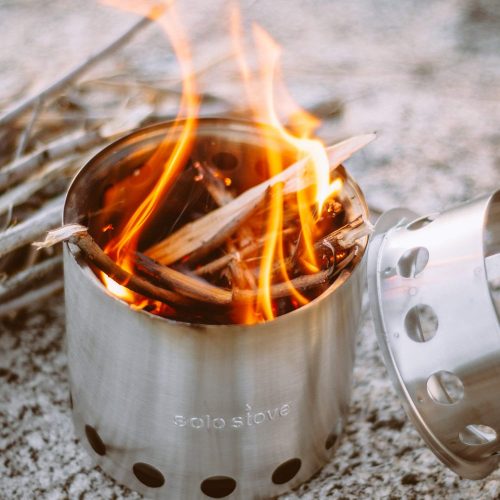
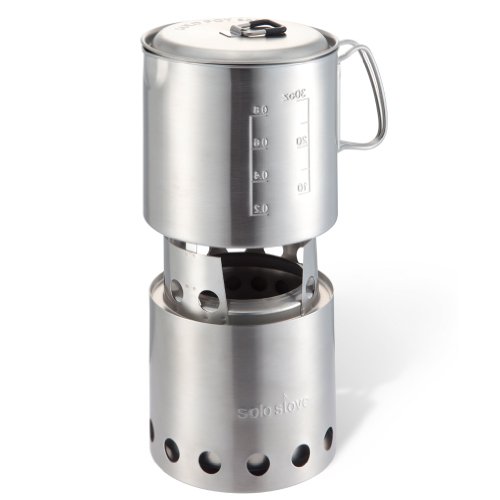
In this review I shall be testing out the Solo Stove Lite with the additional 900ml cook pot. These wood burning stoves are a complete cook system that can use wood and many fuel sources and are ideal for camping or bushcraft.

Pressurised gas canisters, gels and various liquids are very common and most work well. So we have a good choice to suit our needs and situation.
In prepping we try to eliminate as many of the 'what ifs' as possible, so having to carry a stock of fuel, that will potentially run out, can present us with a problem.
For those of you who have been out in the wilds for more than a week, it becomes obvious that carrying fuel is a real problem - just how much do you need?
Along with the quantity of fuel you need to carry, there's the issue of added weight in you rucksack - as always 'less is more' so eliminating the need to carry ANY fuel has got to be a big plus, in any situation.

The answer to this fuel problem is pretty straightforward and the easy solution is using the fuel source that's all around you, i.e: use natural materials, wood, cones, furns etc.
All these natural fuels will create heat to boil your water and enough heat to cook your food.
Of course, as always there are plenty of wood burning stoves to choose from, and if you go right back they were very simple tin boxes with a hole to feed in some twigs.
But wood burning stoves design has moved on:
In this article I want to run through the new designs that make the new cooking stoves so much more efficient and better than before.
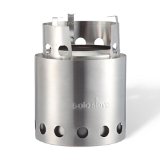
The stove I am using here is the Solo Stove Lite: Ultra Light Weight Backpacking Stove

Here’s the principle behind the super efficient, smokeless Solo Stove:
As the hot air rises, it pulls air through the venting holes in the bottom the the stove.
This is helped by the absence of oxygen that has been created by the actual combustion process.
This introduction of new air not only fuels the fire at the base, but provides an extra boost of 'pre-heated' air through vent holes at the top of the burn chamber.
This type of stove design also has a double wall and makes the Solo Stove Lite a natural convection, inverted, down-gas, gasifier stove....!
To be honest, I don't know quite what all that means, but I do know it certainly works..
The extra burst of preheated oxygen that feeds back into the actual firebox area through the small holes at the top part of the stove cause a secondary combustion.
This secondary combustion phase now allows the fire to burn more fully and is the reason why there is very little smoke during full burn phase.
Whether your out practicing bushcraft skills, wild camping or practising some stealth camping for bug out, the very last thing you want is to be giving away exactly where you are.
Having a camp fire and not being able to control the smoke plume means you will be sending up smoke signals to everyone around for miles away.!
Look at me - I'm over here...!!!

The advantage to this secondary smokeless burn means a far more efficient burn cycle, which in turn means you'll be using a lot less wood compared to an open camp fire.
In effect these type of wood burning stoves don't just burn wood you feed into it - It actually cooks the smoke out of the wood and then burns the smoke not once, but twice.!

Referring to the diagram, you can also see the the cooking ring on the top - the angled lip also increases the stoves overall efficiency as it directs the heat towards your cooking pot, again this results in minimal heat loss.
Having the raised cooking ring also has the advantage of providing a windshield, but still allows oxygen to flow inward.
This system is one of the most efficient types of wood burning stoves you'll ever own.
Previously I have tested out the older styled camp cook stove, so I thought it about time I reviewed a newer, more fuel efficient cook system.
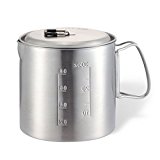
This particular Solo Stove I tested also comes with a 900 ml, stainless steel stove pot:
prices & details here:
Solo Stove Lite & Solo Pot 900 Combo:
This setup is very good as the stove will fit very nicely inside the pot, making the whole lot nice and compact.
Plus that combo only weighs 17oz.....[ 0.48kg ]
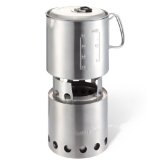
Video Review:
Solo Stove Lite & Solo Pot 900ml for camping or bushcraft
Solo Stove lite Prices & Availability:

how to use a compass for land navigation
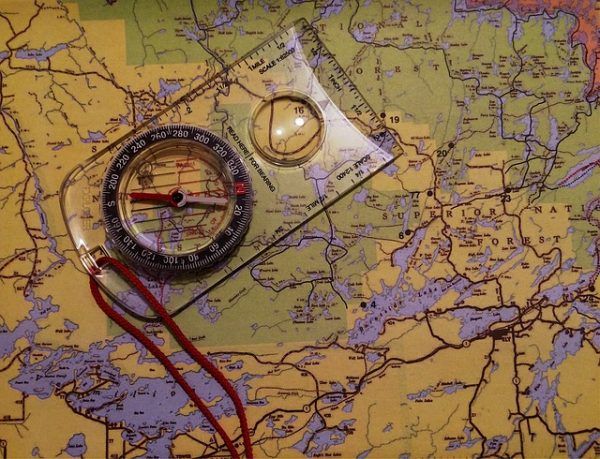
You'd be amazed at the number of bushcrafters and explorers who get lost, even though they have gone prepared with a compass in their pack.! They simply do not, or have not bothered to find out How To Use A Compass For Land Navigation
Most of the time they get lost simply because they think they know where they are going. Maybe they have been there before, but going a few metres off your trail is unknown territory.
People tend to assume that if they do not actually know which way they should go, then a map or compass are of no use to them. This is totally wrong, of course.
You have a map and compass in your pack because every survival manual you’ve ever read say to carry one.
That, in a nutshell, is the problem. There is a big difference between actually having all the right tools with you and knowing just how to use them properly.
The Silva Compass Expedition 4-360, shown here, is probably one of the best survival tools to own and by most accounts the easiest to understand and use.


You must be able to focus on an object and walk toward it to maintain a straight course.
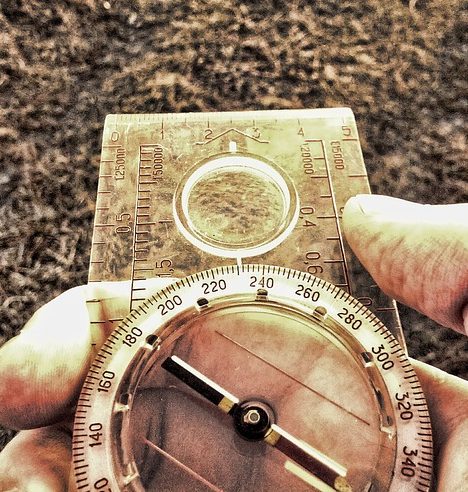
This is why people who do become lost just a few miles from camp or their home and then cannot manage to find their way back.
Lost hikers can literally walk for days and never get anywhere.
Your compass is a very simple tool to use. The needle [normally coated red], will always point towards north, 0 degrees.
Using this basic knowledge, every other angle is the direction you want as a heading.
All you need to do is find that heading with the help of your topographical map.
This video shows the basic way to set and use your Silva Compass Expedition 4-360, for survival navigation.
The needle always points to magnetic north, which is not true north on your map so you have to align the two if you have a destination plotted on the map.
Lay the compass on the map and turn the map until north lines up with north on the compass needle. If you know, your current position on the map then draw a straight line using a protractor from your destination back to your current location.
Line the compass up along the line, mark where the line falls on the degree lines, and make note of the degrees, it may be 270 degrees west for example.
Now all you have to do is raise the compass and maintain a course of 270 degrees this is the visual aid needed.
You now can walk too your destination without having to see it to maintain course.
You may lose sight of it because of terrain and so forth but you can raise the compass and align yourself with the 270 degrees.
*Finding your current location using a topographical map is called triangulation.
In order to plot a course to your final destination using your map, you must first determine your actual position and make it on your map as follows:

Take a good look all around you and try to find at least three distinct landmarks that are in the same general direction you are heading..
Having identified your chosen landmarks on your map, you can then use your compass to determine the actual 'bearing' from the landmark to you by lining up your compass, simply mark the degrees and draw a line from the landmark along the degree line back from the landmark.
Continue to do this with the other two and where the lines intersect is your present location.
Using a protractor can make this a bit easier to plot your course on your map.
Make sure, however, that the needle on the compass is pointed in the direction of travel, as you draw the lines otherwise you will be walking in the complete opposite direction.
Lost Without a Compass or Map
We all know that the suns rises in the east and sets in the west: so a point of reference can always be found at dusk and dawn.
But, if you are simply unable to walk in a straight line you cannot make your way back to civilisation.
Of course, if you can actually manage to walk in a straight line for enough miles you will obviously come upon civilisation.
This is definitely not something you count on though - In theory because of the UK's population density of some 65 million people, walking in a straight line or in a relatively straight line for only 30 miles would probably bring you to somewhere, but that does not necessarily mean civilisation.
With a reasonably sunny day you can use the sun to create a shadow which will give you a Northern bearing and a point of reference to start from.
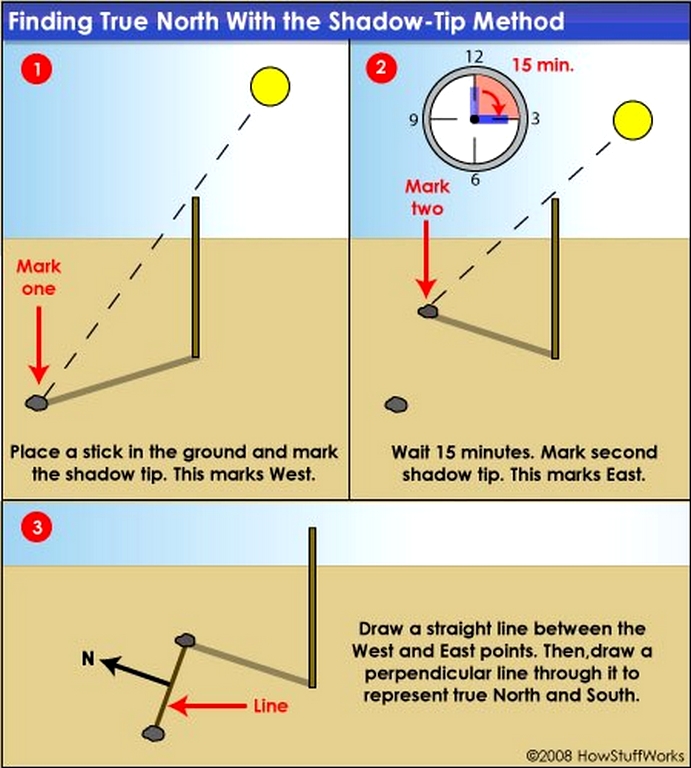
Another straight line walking method is to ensure the sun is always on one shoulder, and keep it there to maintain course.
You can also pick out and focus on a prominent landmark in the near distance, walk to it, and then do the same again with another landmark.
Use the sun to stay moving east or west. [via the sun on shoulder method]. then, once you know east or west, you know that North is on your left if facing east and of course south is on your right.
Always make a note a the main landmark in the direction of your travel before it gets dark.
That way, when it is daylight again you know your direction of travel even if the sun is obscured because of heavy cloud cover.
If you find a river then walk down stream to find civilisation.
Most original settlements and cities began around major waterways and most of the towns and cities are still there today.
The river or stream will never just run in a straight line, but you can cut across areas where possible and avoid having to follow every twist and turn.
Just make sure as you can keep the river on either your right or left side.
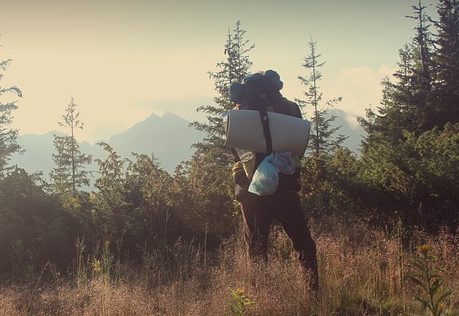
Finally – owning a good compass is an essential part of your survival kit when venturing out and must be part of any bug out bag.
The Silva Compass Expedition 4-360 is definitely one of the best and most tested navigation compass used by hikers and survival experts.
By learning map navigation skills and compass reading you are gaining a survival skill that can literally save your life and get you out of danger and safely home.

Surviving is all about thinking on your feet and adapting to the situation.
Prepping is all about being ready for that situation before it happens.
Don't get caught out - get prepared first.
Steve Hart - UK Preppers Guide
Do you know the five c's of survival?
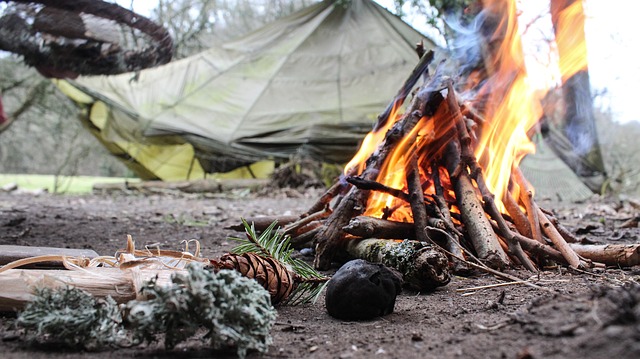
Finding yourself caught out in a dangerous situation is going to pose several different survival scenarios, all unique but nothing that can't be overcome with the correct gear in your pack.
Having any one, or a combination of the five C's of survival will give you a greater chance of making a bad situation better and more comfortable until you get out of trouble or help arrives.
Whether it's bushcraft, Survival or Prepping, these basic rules apply.

The more knowledge you have on a subject, the easier it will become.
This applies 100% to surviving.
So although we are covering the five C's of survival, essentially they would rendered useless without any knowledge of bushcraft and prepping in the first place. Learn as much as you can and apply the 5 C's........
the five c's of survival
* Each 'C' also overlaps other survival tasks and priorities.
e.g: poncho or tarp
- First-Aid or Self-Aid – protecting body temperature
- Shelter – gives cover from elements, helps protect body temperature
- Signalling – bright colours attract rescuers
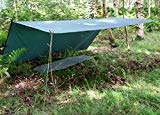
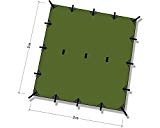
Although there are many companies offering tarps for less money, I have several DD Tarps and I would highly recommend over their competitors.
They are very good quality and offer a great range of sizes and colours.
The 4×4 is enormous with tie point at every corner and across the tarp, making every configuration possible.
They are also light and one thing I especially like about the DD Tarpis that they give you a decently sized stuff sack for each tarp size.
I can’t stand fighting with a tiny little stuff sack to put my gear away!
e.g: knife or axe
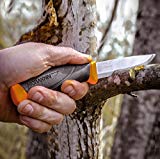
Your knife doesn't have to be an expensive, custom, hand made one either:
Just a simple, straightforward knife like this Mora Outdoor Companion would be enough to do most tasks.
There the right size to tackle most jobs and tough as nails!
See my other article where I do a complete rundown on the types and quality of the Mora Knife here: Mora Knife Review
e.g: lighter or fero rod
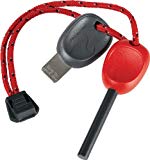
Again the Ferro Rod you buy does not need to be one of those super rods on the market.
I have found the Light My Fire ferro rod to be a very reliable tool when it comes to producing a shower of excellent sparks.
I would highly recommend it…
e.g: paracord or bankline
- First-Aid or Self-Aid – makeshift slings, tornaqui or assisting a pressure wraps, and bandaging
- Shelter – guide ropes, ridge lines, lashings and securing knots
- Food – animal snares, fishing line/nets, hanging food away animals etc.
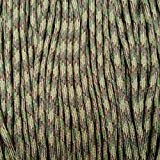
Not all paracord is equal.
The most reliable is paracord that has the MilSpec standard. Namely the 550 standard, which means it has been tested to withstand a minimum of 550lb breaking strain.
The Wild Elk American 550 Paracord, shown here has that standard.
I use this brand all the time and have never had any problems.
e.g: s/s water bottle or billy can
- First-Aid or Self-Aid – infusions: herbal teas and drinks
- Water – boiling up to make safe, storing and transporting water
- Fire – use metal water container to prepare char cloth for fire transportation
- Food – collect wild edibles and cooking
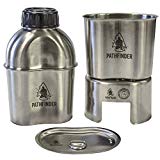
Your container is something I would recommend spending money on.
Quality definitely overrides price here. I use and highly recommend you look at using something like the Pathfinder PTH003 kit.
It’s a bombproof piece of kit, well-made and versatile – you can’t go far wrong here….
So there you go folks, the five C's of survival.
Cover, Cutting, Combustion, Cordage and Container.
Always have these five items to hand and your half way there to surviving.
Of course don't forget, never stop learning about Bushcraft, Prepping or Survival, because this lot wont help you at all if you don't know what to do with it..!!
Steve Hart - UK Preppers Guide
this is how to build a basic survival shelter Easily

- Don't go out unprepared.
Always carry a temporary emergency shelter with at all times, along with the right footwear and clothing. - Pick the right spot.
Choose an area that will give as much natural cover even before you have put up a shelter. - make use of natural surroundings.
A fallen tree will make great cover and protection, make use of it. - Keep it small and compact.
Don't make a massive mansion! Your shelter must be just big enough for you to crawl in, this will make heating up sounding air space more efficient. - insulate the ground.
Use natural material to layer the ground and form a insulated layer. The thicker the better,
Every prepper or bushcrafter should be prepared for an emergency. You should have the necessary kit in your rucksack to enable yourself to take shelter from the elements. With this kit you can then build a basic survival shelter.
This is the easiest and most straightforward method. After all if you going out in the wild you would at the very least have a day sack with you.
A survival shelter is a priority once you find yourself lost or stranded or you simply realise you cannot make it back home before dark.
The rule of three for survival states you will need a shelter within three hours. However, if in a cold climate, you will need to build a survival shelter almost immediately to prevent hypothermia.
So time is important and the more time you spend exposed to the elements the worse things get.
Getting yourself out of those conditions and building a cover that protects you from the elements, predators, and insects and provides comfort is paramount.
Essentially, you need it as much for your mental well-being as you do for your physical well-being.
In this article I show the simplest gear to carry in your rucksack,
gear that will enable you to easily build a survival shelter.

Survival Shelter materials
Ideally, you will have shelter material in you pack along with tools and materials such as quality cordage, knife, axe and wood saw.
Otherwise, you can use materials found in your environment and you can take advantage of natural features.
everyone carries a tarp
It is always worth carrying an emergency tarp like this DD 3m x 3m Tarp (Multicam Tarp/Basha) shown below – it will get you out of lots of situations…
Secure your tarp to the top of the downed tree and slant to the ground on the north side in cold weather. Secure with wooden stakes or rocks. Peg out to form a cover shelter, as you see below, or any combination to suit conditions.
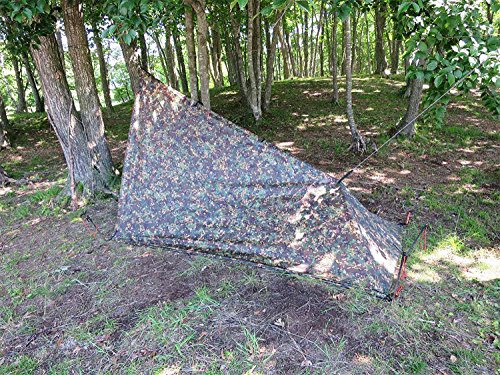
You can also use a poncho, tarps, thermal blankets, local vegetation and woodland. All these can be used also as survival shelter materials.
But once you realise you are lost, you must have a shelter constructed before dark.
It is always recommended that you shelter in place and begin setting up camp immediately.
Always stop for a minute and evaluate your surroundings for material.
When it comes to tarps, do not buy cheap. You will definitely regret it and when you do it will be in the middle of the night when it's windy and raining..!!!
The tarp is one of the most versatile bits of kit you can have with you.
It is light, compact and can be formed to many different configurations to suit the conditions. Below are just some of the different layouts you can use:


See all the different tarp sizes and colours here: DD Tarp systems
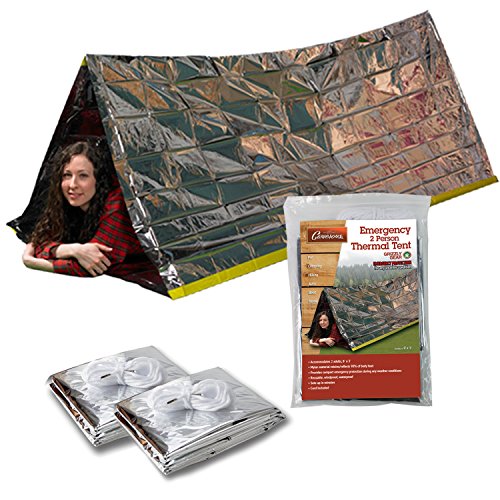
Another system well worth considering is the pre-made emergency thermal tent:
It’s even possible to build yourself a basic survival shelter from Reflective Mylar, this will give you, in effect, an emergency thermal tent, being both warm and waterproof.
I particularly like this idea as it is very light and compact.
Quite often it’s a good idea to use short Bungee Cords to secure your tarp rather than rope or paracord. This will ensure a bit of movement in windy condition and prevent any extra force on your tarp.
I often carry bungees and without a doubt find them very useful to have with me.
Take advantage of your natural surroundings
The most simplest type of shelter is simply to get under a tree, sheltering under a low hanging branches if possible. It will prevent any rain getting to you and if you use the limps to block the side, will give protection for the wind.
However, if you have time and available daylight think about making yourself a quick, low level 'lean too' survival shelter. But being prepared with a tarp or mylar blanket is probably the quickest and easiest method to build a basic survival shelter.
Building a survival shelter is the most important thing you can do if you find yourself stranded in the wilderness.
A shelter will make the difference between surviving and not and you will find you can survive extremely harsh conditions if you have protection from the elements.
Wandering around looking for help will only slow down rescue personnel.
Stay in place, and set up camp and wait for rescue.
Steve Hart. (UK Preppers Guide)
Wild Camping or Bug Out
Cooking Stove Review Bushbox XL

The perfect wood burning stove for wild camping or bug out
First of of a decent cooking stove is an essential part of your bug out kit and as such needs to meet a few specific requirements to be considered worth taking with you.
- Must be compact to carry, yet big enough to maintain a good amount of heat to cook and boil water.
- Uses basic fuels, namely wood.
- Easy to maintain a constant fire
- Easy to clean
- Reliable and solidly built
The cooking stove I chose to come with me on a few nights wild camp was the Bushbox XL (extra large), made by the Bushbox company based in Germany.
The Bushbox XL is the bigger brother of the Hobo Stove

Bushbox XL in action.
The XL version I am reviewing here has a radically new design which makes this stove very compact and extremely easy to set up, fold down and carry.
In fact, the XL is possibly one of the easiest to assemble survival stoves that I have ever known – it goes from folded down to being ready for use in seconds.


Folded down and inside its carrying case I measured the overall dimensions to be only:
210mm x 95mm x 20mm thick MAX. – Weighing only 800 grams.
This was an comfortably acceptable size and weight to carry considering the finished, usable size of the stove.
*The Standard XL comes as just the stove with the two trivet stands and is packed in a fitted cotton pouch.

The Bushbox XL that I have here has additional accessories that make up the Combination Kit, and these are a heavy duty outdoor carry bag and a Universal Grate.
This setup is very good and gives you the custom made carry bag to fit everything in to.
This kit is currently priced under £86 inc. VAT & delivery.
Furthermore I think it's well worth spending that extra bit more for the combination kit. As it gives you all the extras you need in a cooking stove.
The outdoor carry bag is very well made and fits the stove plus the universal grate perfectly.
The universal grate can be bought separately.
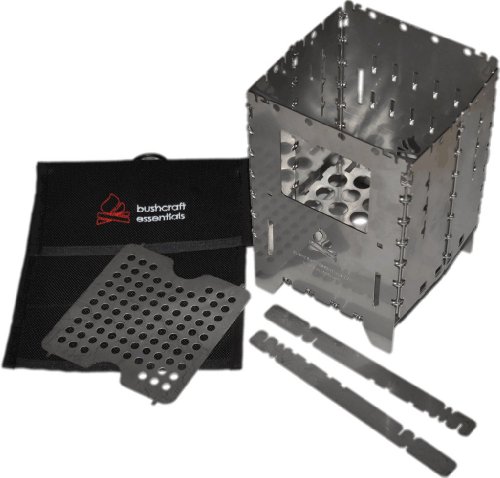
Another very good use I found for the universal grate was to use it with a Trangia Spirit Burner

The carry bag also has a sewn in ‘D’ ring which, again, is very well fitted and would need a lot of pulling about to work loose.
This is a good feature as it means everything can be easily attached to your rucksack leaving valuable space inside.
So all in all, I'm glad I have the combination kit as opposed to just the Bushbox on its own. For the sake of an extra £10 or so, I think it's well worth getting.


This is my video review and test of the Bushbox Xl Outdoor Survival Stove
As you can see in my video, the Bushbox XL had a good field test and certainly worked 100% on a rather cold and chilly day ( the water in the cup was certainly well below 10 deg C ) but there was absolutely no problem starting and maintaining a good amount of heat - the opening where you can feed the twigs into makes everything so easy and maintaining the fire was simple.

One point to note:
Keep the ash pan ( bottom tray ) clear of any debri or fallen ash, I just used a longer twig to brush it out.
If it builds up you loose air flow through to the fire grate ( I had to clear the ash a couple of times ) by keeping it clear there was none of this huffing and puffing at the fire that you normally get with some wood fires..!
So, a final verdict on the BushBoxXL - can't be anything other than excellent.
The design is very good, it's compact and easy to store, works exactly like it's supposed to do, kept a nice tidy fire going for as long as I wanted and folded away simply and easily at the end of the day.
I would definitely advise any hiker, camper or Prepper to get one of these as a serious addition to your survival kit.

What wasn't included in the video was the fact that once the water boiled I removed the cup and stocked up the stove with some more larger twigs.
... and made myself a lovely camp fire which burned for ages and gave off some nice heat - just to finish off the day nicely.....
Happy Prepping Folks,
Steve

Other bushbox review articles
Great value for money everyday carry knife

In this knife review I'm looking at the Grizzly Bushcraft Buddy Camo Unisex Outdoor Pocket Knife. It's a UK legal carry knife at a very affordable price.
I decided to review it because it was recommend to me by a friend who just purchased one and was raving about it!
So I just popped over to Amazon and bought myself the knife to try out.
Fortunately I use Amazon Prime so I saved myself a cool £4.99 on postage as well as getting it the next day, result...

So, the knife duly arrived the next day as promised and, although I had not real use for the packaging, I must say it was wrapped up good as to prevent damage, and was inside in its own box.
When inspecting the knife, I could see there was no damage or scuff marks on it at all.
A1 condition and top marks to Grizzly.

first impressions of the grizzly bushcraft buddy
Most noteworthy, straight out of the box, although there wasn't really a box to open, the Grizzly looked the part.
I chose the camo version although there is a choice of three handle versions, shown here:


Amazon reviews?

Before I anything on Amazon I checkout the reviews, just to get a feel of what people as saying and so checking out this knife was no different.
At the time of writing this knife review there were some 236 reviewers, giving a 61% five star review, 16% a four star and only 6% giving one star.
To be honest, most one star reviews sited the blade needing sharpening! Well, all blades need sharpening at some point!
I always give a new blade a blast on the strop before I use it, and your going to have to sharpen it at some time.....
So needless to say, that didn't worry me...
Grizzly Bushcraft Buddy review
Let's get a few statistics out the way first:

The blade is blend between a drop point and a spear point, with a square flat grind to the top.
The actual grind on the cutting edge is a standard double bevel, making it super easer to hone to a fine edge.
I have found that this type of edge grind gives you greater strength than the majority of edge shapes due to the amount of blade thickness behind the cutting edge.
legal UK carry?

With the specifications above, the Grizzly Bushcraft Buddy becomes perfectly legal to own, carry and use here in the UK.
With common sense....
For that reason user discretion is advised, especially in certain places where they may have there own specific rules in place regarding carrying knives into private buildings.
Furthermore it could be argued that the blade is close to a spear point, the law exemplifies this as this is a non locking pocket knife with a blade under 3" and, as such, it is exempt from S139 Points & Blades section
uses for this type of knife
Although advertised as a bushcraft knife, I would say it depends very much on what type of bushcraft you are doing?
Whittling, cutting paracord etc, a resounding yes. Battoning or chopping of large logs, no. But then again, use an axe for that!!
in this video i run though the features of the Grizzly Bushcraft Buddy
is worth it?
I have absolutely no problems in recommending the Gizzly Bushcraft Buddy Outdoor Pocket Knife.
Consequently it's fantastic value for money, and does exactly what it says on the box!
In fact I would go so far as to say; You would have you deliberately try and brake this knife to get it to fail.
I paid £18.99 all in for mine [in delivery, through Amazon Prime].
But If Your Reading This Months From Now, It May Of Changed. Check Price Here On Amazon
As you saw in my video, I tried to kill it! I abused it, something I wouldn't recommend, and it still survived.
So for what it's ment to do, it outperformed my expectations.
As an everyday carry pocket knife it's ideal.
As an 'around the home' utility knife it's ideal.
But most of all, as a bushcraft pocket knife.
It really works for me.
Steve Hart - UK Preppers Guide
Emergency Preparedness
HEATSTROKE

Heatstroke Prevention must be part of your emergency preparedness, however, in some cases you may not be able to prepare properly so it is important that you know how to protect yourself using what is available in your environment.
Preventing injuries, and being proactive in protecting yourself against things like hypothermia, hyperthermia (heat stroke), frostbite and dehydration can ensure your survival.
Knowing what the possibilities are can go a long way in preventing certain things from happening or developing.

Heatstroke and dehydration are not synonymous, as some may believe. Heatstroke is the failure of the body to regulate its cooling system because of exposure to high temperatures.
Dehydration is simply not enough fluids in the body for normal cell and organ function and it is fatal once the body loses 15 percent of its fluids.
You cannot go longer than 72-hours without adequate hydration.
In some extreme cases, you may survive longer than three days but this would require that you do not move essentially.
There have been reported cases where individuals have survived longer than five days without any liquids but the cases are extreme examples of survival and no one should ever expect the same results.
The body is cooled by the evaporation process. Sweat on the skin begins to evaporate cooling the skin and ultimately the blood in capillaries, veins and arteries that are close to the surface. Warm blood flows from the organs to the surface to be cooled and then travels back to the organs to cool them. You can help keep the body cool by wetting your clothing and keeping your head covered with a wet cloth.

Hyperthermia Symptoms and Signs
- Coma.
- Confusion.
- Elevated Heart Rate.
- Fainting.
- Fever.
- Headache.
- Muscle Cramps.
- Nausea.

If your body is unable to sweat because of a lack of fluids or some medical condition your body can overheat if you cannot cool it by other means.
You should conserve sweat and never attempt to ration water.
In hot climates to reduce sweating, and to conserve bodily fluids you should not exert yourself during the hottest parts of the day.
Staying in shaded areas can help slow the dehydration process and help prevent heatstroke.
Once your core body temperatures reaches 40.5ᵒC (105ᵒF) it must be cooled immediately or it is fatal.
Treating Heatstroke

If possible submerge in water. If not possible, ensure they are out of the direct sun and then cool the head with wet cloths as well as the rest of the body, give fluid, lie patient down and raise the feet..
An essential part of your emergency preparedness plan must include familiarisation with these conditions, as they can often lead to a fatal situation.
As a prepper you must ensure you have prepared for this scenario and carry the necessary equipment in your EDC or Bug Out Bag.
Carrying a instant ice pack in your first aid kit will help with cooling, and can be applied to the patient to help reduce temperature.
The patient should be encouraged to drink water and re-hydrate, and if a normal water source is not near it will be necessary to use any old water source and filter through a good water filter bottle.
If it is not possible to get away from direct sunlight,
Form a makeshift shelter: this can be done in a basic form using branches etc and then clad over the top using a couple of survival blankets or a survival tent over the top to give
One of these will give you an 8'x10' shelter for under £5 - click here to find out more info.
Typically, as a prepper, and if there was a risk of heatstroke, you would ensure you had the correct equipment with you and planned your day in a fashion as to ensure you did not overwork yourself and thus overheat.
Being ready with a good level of emergency preparedness will ensure that you do not become a victim in any survival situation. Having some simple equipment can mean the difference between surveying or not..!
By simply having the knowledge of how to recognise and treat heatstroke, you are giving yourself an survival advantage.
The sooner you are able to treat someone, the quicker they will recover.
You must be knowledgeable of the Top 5 Survival Skills in order to ensure you are ready for such an emergency.
1. Know how to build a shelter and set up a camp
2. Know how to start a fire using foraged materials
3. Know how to find water and filter it or to distill water from the sun
4. Know how to set snares, traps, fishing and hunting skills and gathering food from the land
Wilderness Gathering 2018
Bushcraft And Survival Show

Undoubtably The Best
Bushcraft Show In The UK.
The very 1st Wilderness Gathering took place in 2003 at The Bison Centre, West Knoyle in Wiltshire, and every year the show gets bigger and better,
Over the years I have seen this event grow from a small event in one field with some traders and schools sharing Bushcraft skills and knowledge, to a festival of wilderness living skills encompassing Bushcraft, survival and woodland crafts, and, of course, prepping.

The show has grown into an event with something for all the family with stories and music by the campfire in the evenings and skills workshops and activities throughout the five whole days of the festival.


WHAT’S THE WILDERNESS GATHERING ABOUT?
If you've never been to the Gathering before and you love nature and the outdoors, then we have the family show for you:
Wilderness Gathering, a unique Bushcraft event, is the longest running and still the original festival of bushcraft, survival and primitive living skills.
The Gathering has become a social event and brings together families and friends, all those interested in Bushcraft and Wilderness living skills to enjoy a weekend of knowledge sharing in a relaxed and family friendly atmosphere

The show has Bushcraft clubs for all age groups of children to get involved in plus more activities for all including den building and wilderness skills classes for all ages.
There are hands on demonstrations of game preparation, knife sharpening, basha boat building, archery and axe throwing and primitive fire lighting to name just a few.
All of these skills are there for everybody and anybody to participate in.
The Gatherings Is A Full On
Family Bushcraft & Survival Event
All the younger children are hugely catered for at the show with their own bushcraft section for under and over 10's.
The "Coyote" & "Coyote Kids" can join in with a full program of bushcraft and survival related skills and activities.
I was very proud to be included with the instructors and work with the Coyote Kids activities last year in 2017 - and I'm very much looking forward to joining the team again this year.
Children's events range from Nature detectives, tracks and signs - Woodlife Trails for the Coyote Kids right up to Pine Resin & mounting Arrowheads for the older Coyotes.
Knife safety is run every morning and children have a chance to learn carving and whittling skills under full supervision - and they all love making various wooden crafts..!!
link to Coyote Kids events page here:


For the rest of us adults there's an amazing amount of bushcraft and survival skills going on each day to keep even the most hardened bushcrafter or survival enthusiast busy all day long.
You really do learn so much at this show, and it's no wonder, with expert demonstrations, lectures and hands on skills from some of the foremost experts who are always happy to help and impart their knowledge to everyone.
Prepping At The Show:
For preppers, bushcraft gives us a firm grounding on which to base our prepping tactics, and prepping for when the SHTF, and we are not missed out either.
Lectures from renowned prepper, Tom Linden, on why everyone should prep are free for everyone to attend.
For Die Hard Bushcrafters:
Just about all aspects of bushcraft and wild survival are covered by the many instructors at the show.
An amazingly friendly bunch of talented men and women.
I find, every year, I learn something new that can be applied to my prepping skillset, and I'm sure you will too.

Checkout the show website here:
Wilderness Gathering Webiste
Or you can call for information:
0845-838-7062
If you want to learn real survival skills, from real experts, then this really is the show for you..
See you all there folks.....


"
The Wilderness Gathering is, without a shadow of doubt, the most absorbing show on the 2018 Bushcraft & Survival calendar.
I have been going for many years now and it just gets better and better with so much to do - especially for the children.
It is not just some money making event wrapped up with a bushcraft logo - it's the real deal.
Highly skilled and talented experts willing to impart their knowledge freely.
I don't think there's any other event where so many talented bushcrafters are together at one time.
Bushcraft (and prepping) is all about us adults learning more skills, and teaching and passing on our knowledge to our children and young people, as well as sharing to everyone who wants to learn new skills.
If you only go to one show this year - then this is the one, and if you see me around, say hello.
I hope to see you there.
Steve Hart - UK Preppers Guide
The Atmos
Compact Modern Longbow

2018 Preview of the eagerly awaited longbow from Survival Archery Systems.
Launch dates and availability are expected to be June this year with a very high interest in the bow already, and in order to really push this project along, the driving force behind the new Atmos bow is founder of Survival Archery Systems, Doug Shadwell.
Doug has launched a kickstarter programme to really speed things up and get this bow out to the public.

The ATMOS Modern Longbow *shown here in its camo livery
This is the current available colour options:
This longbow looks to be the ultimate bow for preppers and hunters alike, and is part of the overall development of the SAS bow family.
High performance, high quality and specifications, along with the ability to maintain compactness seems to be Doug's driving force behind the range of SAS bows.
Take a look at the efforts made in the design and manufacturing process in this video here:
Specifications:
The Atmos Modern Longbow

It would seem a lot of consideration has gone into every part of the Atmos design and build process, and that includes the final livery colouring.
Below are the four available colours, and I think you'll agree, all look every bit a profession quality finish:


I also want to include this excellent review video by David, from the American website Ultimate Survival Tips.
Here is David's review:
Having already written articles on the two previous SAS bows myself, with video reviews, and manufactured from Survival Archery Systems:
The SAS Recon Folding Bow:
The SAS Tactical Survival Bow:
I have been following the progress of the new Atmos longbow with interest. It certainly ticks all the boxes, and more for any prepper, or bow hunter.
Interested To Know More About
The Atmos Modern Longbow?
Take a look at the current offers and packages available to backers on the Atmos kickstarter page right here..
Backing this project will help Doug make this the best bow ever made for us preppers.
Happy prepping folks, Steve