



How to Stop Bleeding Quickly using Black Pepper
Simple, Easy and Inexpensive - Survival 1st Aid
Making sure you are carrying all the essentials for survival is not easy. In fact, it's pretty much impossible. So we do the best we can under given circumstances.
Ensuring there's enough food and water are a big concern, unfortunately there are many areas where you can fall short and by not having one bit of equipment, you can ruin your survival chances.
In a survival situation one of the worse thing that can happen is sustaining an injury. Everything else becomes irrelevant if you are not able to move about. Sourcing food and water would become almost impossible.
A bad fall or a laceration is something that requires immediate treatment - but a large open cut that is bleeding, is far more serious and requires treatment to halt that bleeding as soon as possible.
It's just not possible to pack everything in your 1st aid kit.
What you put in you 1st aid kit is personal to you and your needs. These will all differ slightly from another persons emergency kit.
But generally most things items in any kit remain constant - by that, I mean the bandaging, wraps, medication etc. Blood clotting agents are generally an item that you must add yourself.
You can get smaller, more specific, trauma kits like the 'QuickClot Trauma Kit' shown here. But it will not include most of the emergency 1st aid equipment you have in your own kit.
These kits are very specific and designed mainly for stopping bleeding as fast as possible in an emergency.
Something like this is well worth considering if you have room in you survival pack.
It is also a very useful item to include in your car survival kit.
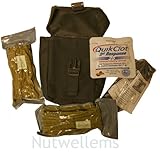
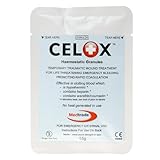
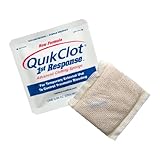
The individual clotting kits like the 'Celox or QuickClot' are designed to give very fast clotting and are in the form of a bandage type, sterile, nonwoven gauze that is impregnated with a clotting agent. The gauze can be use to treat any bleeding wound anywhere on the body.
They are a 'one off' treatment and will stop bleeding quickly - It's well worth packing at least one these in your kit. Even better is to ensure every member of your group has one.

So what about lesser open wounds that require attention?
- Lesser injuries should be considered as potential show stoppers as much as a large open wound.
It is important to remember that, and as such, stopping any bleeding of an open wound in a survival situation must be given immediate attention. - Simply tripping over and cutting a finger or bashing into things can easily result in a cut or an abrasions to your skin.
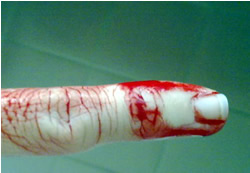
- For this type of 'lesser' blood injury you do not want to be wasting a full blood clot pack. It's just not needed. Save them for real 'life or death' situations, if they were to occur.
- Instead there's a very simple bushcraft solution to the smaller blood injury.
These 'lesser' injuries can still prevent you from carrying on, but more importantly, if not treated they will get worse putting you in more danger. A simple cut, if not treated, can easily get infected - it is essential to treat all wounds immediately.
Strange as it may seam - Ground Black Pepper will stop a smaller bleeding wound.
By carrying some black pepper seeds in a self grinder bottle, the type you can get from any supermarket, you have an instant dispenser to administer directly onto a small open wound. The pepper will not hurt the patient in any way and will not sting your skin.
Once the ground pepper is over the cut or abrasion, press it firmly into the open wound.
Wrap the wound as best you can, with whatever you have to hand - obviously the more sterile the better. This is where you standard emergency 1st aid equipment comes in to play.
This method is simple and straightforward and will definitely help in stopping the bleeding from a smaller open wound.
This is tried and tested bushcraft survival skill. To the best of my knowledge it is not a medically approved or endorsed method.
I have used it and all I can say is it worked for me.
Obviously for a bigger wound the blood clotting pads are your first choice - but we are talking survival and prioritising the use of essential equipment where possible.
Don't get caught out - get prepared first.
Happy Prepping Folks.
Steve

Keep updated with all the latest prepping news and information
* Enter your name & a valid Email address
* You will receive an Email titled 'Preppers Newsletter Subscription'.
* Simply confirm to have access to our regular newsletter and also get your free PDF copy of: 'Beginning Prepping'








6 comments
Skip to comment form ↓
Richard
May 30, 2015 at 7:46 am (UTC 0) Link to this comment
Like the ground pepper trick for small cuts
John
February 27, 2015 at 6:46 am (UTC 0) Link to this comment
Some of those little sachets you get at fast food outlets would be easy to slot into an EDC – some of them are ‘pepper substitute’ tho – would that make any difference?
I used to work in a hospital and a trick we used to use for shaving cuts was to liberally apply some talcum powder – it stems the bleeding very effectively.
Another trick I find that works for me for cuts to digits, is just to cut the finger/thumb from a nitrile glove, apply it like a finger stall, then just tape around the junction between it and the finger/thumb – I always carry about 20 gloves in my EDC.
I also carry some small tubes of superglue (nips a bit!), which can seal wounds – you can get tubes of the medical stuff.
If the cut is under hair on the scalp, hair on either side of the cut can be tied together, to pull the wound together and then pressure applied.
UK Prepper
February 27, 2015 at 10:19 am (UTC 0) Link to this comment
Some good ideas there John.
The glove one is great, especially as they are normally quite sterile to start with.
Thanks for your advice..
John
February 28, 2015 at 12:32 am (UTC 0) Link to this comment
Normally the idea of this type of glove is to protect the wearer from something they may catch from someone else. They’re not sterile ,unless you can get hold of the surgical ones (some of which come with a sachet of a starch type powder, to aid getting them onto the hand (which may also be used to stem bleeding)), but, I’m sure they’re better than an open wound – IF you cleanse/irrigate the wound first! If you have shuck and mite on yer skin, it’s a perfect little greenhouse for bacterial growth!
Jake101
February 27, 2015 at 10:32 am (UTC 0) Link to this comment
I like the glove idea too.
Simple and effective. why didn’t I think of that one before!!
Nice one John.
"Danny" Harold Kaye
November 12, 2015 at 7:13 pm (UTC 0) Link to this comment
“superglue (nips a bit!), which can seal wounds” – superglue was invented with the specific purpose of sealing wounds (in Vietnam War).
DHK